Senin, 28 September 2015

Swallow

Red-rumpedSwallow01.jpg
Red-rumped swallow

The swallows and martins are a group of passerine birds in the family Hirundinidae that are characterised by their adaptation to aerial feeding. Swallow is used colloquially in Europe as a synonym for the barn swallow.

This family comprises two subfamilies: Pseudochelidoninae (the river martins of the genus Pseudochelidon) and Hirundininae (all other swallows and martins). Within the Old World, the name "martin" tends to be used for the squarer-tailed species, and the name "swallow" for the more fork-tailed species; however, there is no scientific distinction between these two groups. Within the New World, "martin" is reserved for members of the genus Progne. (These two systems are responsible for the sand martin being called "bank swallow" in the New World.) The entire family contains around 83 species in 19 genera.

The swallows have a cosmopolitan distribution across the world and breed on all the continents except Antarctica. It is believed that this family originated in Africa as hole-nesters; Africa still has the greatest diversity of species. They also occur on a number of oceanic islands. A number of European and North American species are long-distance migrants; by contrast, the West and South African swallows are non-migratory.

The lesser striped swallow is a partial migrant within Africa

Description
The swallows and martins have an evolutionarily conservative body shape which is similar across the clade but is unlike that of other passerines. Swallows have adapted to hunting insects on the wing by developing a slender, streamlined body and long pointed wings, which allow great maneuverability and endurance, as well as frequent periods of gliding. Their body shape allows for very efficient flight, which costs 50–75% less for swallows than equivalent passerines of the same size.

Like the unrelated swifts and nightjars, which hunt in a similar way, they have short bills, but strong jaws and a wide gape. Their body length ranges from about 10–24 cm (3.9–9.4 in) and their weight from about 10–60 g (0.35–2.12 oz). The wings are long, pointed, and have nine primary feathers. The tail has 12 feathers and may be deeply forked, somewhat indented, or square-ended. A long tail increases maneuverability, and may also function as a sexual adornment, since the tail is frequently longer in males. In barn swallows the tail of the male is 18% longer than those of the female, and females will select mates on the basis of tail length.

The legs are short, and their feet are adapted for perching rather than walking, as the front toes are partially joined at the base. Swallows are capable of walking and even running, but they do so with a shuffling, waddling gait. The leg muscles of the river martins (Pseudochelidon) are stronger and more robust than those of other swallows.

The most common hirundine plumage is glossy dark blue or green above and plain or streaked underparts, often white or rufous. Species which burrow or live in dry or mountainous areas are often matte brown above (e.g. sand martin and crag martin). The sexes show limited or no sexual dimorphism, with longer outer tail feathers in the adult male probably being the most common distinction.

The chicks hatch naked and with closed eyes. Fledged juveniles usually appear as duller versions of the adult.
 
Distribution and habitat
The swallows and martins have a worldwide cosmopolitan distribution, occurring on every continent except Antarctica. One species, the Pacific swallow, occurs as a breeding bird on a number of oceanic islands in the Pacific Ocean, the Mascarene martin breeds on Reunion and Mauritius in the Indian Ocean, and a number of migratory species are common vagrants to other isolated islands and even to some sub-Antarctic islands. Many species have enormous worldwide ranges, particularly the barn swallow, which breeds over most of the Northern Hemisphere and winters over most of the Southern Hemisphere.

The family uses a wide range of habitats. They are dependent on flying insects and as these are common over waterways and lakes they will frequently feed over these, but they can be found in any open habitat including grasslands, open woodland, savanna, marshes, mangroves and scrubland, from sea level to high alpine areas. Many species inhabit human-altered landscapes including agricultural land and even urban areas. Land use changes have also caused some species to expand their range, most impressively the welcome swallow which began to colonise New Zealand in the 1920s, started breeding in the 1950s and is now a common landbird there.

Species breeding in temperate regions migrate during the winter when their insect prey populations collapse. Species breeding in more tropical areas are often more sedentary, although several tropical species are partial migrants or make shorter migrations. In antiquity it was thought that swallows hibernated in a state of torpor, even that they withdrew for the winter under water. Aristotle ascribed hibernation not only to swallows, but also to storks and kites. Hibernation of swallows was considered a possibility even by as acute an observer as Rev. Gilbert White, in his The Natural History and Antiquities of Selborne (1789, based on decades of observations). This idea may have been supported by the habit of some species to roost in some numbers in dovecotes, nests and other forms of shelter during harsh weather, even apparently entering torpor.
 
Behaviour and ecology
Swallows are excellent flyers, and use these skills to feed and attract a mate. Some species, like the mangrove swallow, are territorial, whereas others are not and simply defend their nesting site. In general, the males select a nest site, and then attract a female using song and flight, and (dependent on the species) guard their territory. The size of the territory varies depending on the species of swallow; in colonial-nesting species it tends to be small, but it may be much larger for solitary nesters. Outside of the breeding season some species may form large flocks, and species may also roost communally. This is thought to provide protection from predators such as sparrowhawks and hobbies. These roosts can be enormous; one winter roosting site of barn swallows in Nigeria attracted 1.5 million individuals. Non-social species do not form flocks, but recently fledged chicks may remain with their parents for a while after the breeding season. If a human being gets too close to their territory, swallows will attack them within the perimeter of the nest.
 
Diet and feeding
For the most part swallows are insectivorous, taking flying insects on the wing. Across the whole family a wide range of insects are taken from most insect groups, but the composition of any one prey type in the diet varies by species and with the time of year. Individual species may be selective, they do not scoop up every insect around them, but instead select larger prey items than would be expected by random sampling. In addition the ease of capture of different insect types affects their rate of predation by swallows. They also avoid certain prey types; in particular stinging insects such as bees and wasps are generally avoided. In addition to insect prey a number of species will occasionally consume fruits and other plant matter. Species in Africa have been recorded eating the seeds of Acacia trees, and these are even fed to the young of the greater striped swallow.

The swallows generally forage for prey that is on the wing, but they will on occasion snap prey off branches or on the ground. The flight may be fast and involve a rapid succession of turns and banks when actively chasing fast moving prey; less agile prey may be caught with a slower more leisurely flight that includes flying in circles and bursts of flapping mixed with gliding. Where several species of swallow feed together they will be separated into different niches based on height off the ground, some species feeding closer to the ground and others feeding at higher levels. Similar separation occurs where feeding overlaps with swifts. Niche separation may also occur with the size of prey chosen.
 
Breeding
The more primitive species nest in existing cavities, for example in an old woodpecker nest, while other species excavate burrows in soft substrate such as sand banks. Swallows in the genera Hirundo, Ptyonoproggne, Cecropis, Petrochelidon and Delichon build mud nests close to overhead shelter in locations that are protected from both the weather and predators. The mud-nesters are most common in the Old World, particularly Africa, whereas cavity-nesters are the rule in the New World. Mud nesting species in particular are limited in areas of high humidity, which causes the mud nests to crumble. Many cave, bank and cliff dwelling species of swallow nest in large colonies. Mud nests are constructed by both males and females, and amongst the tunnel diggers the excavation duties are shared as well. In historical times, the introduction of man-made stone structures such as barns and bridges, together with forest clearance, has led to an abundance of colony sites around the globe, significantly increasing the breeding ranges of some species. Birds living in large colonies typically have to contend with both ectoparasites and conspecific nest parasitism. Old males benefit most from coloniality, since they are able to maintain their own nests and benefit from frequent extra-pair copulations.

Pairs of mated swallows are monogamous, and pairs of non-migratory species often stay near their breeding area all year, though the nest site is defended most vigorously during the breeding season. Migratory species often return to the same breeding area each year, and may select the same nest site if they were previously successful in that location. First-year breeders generally select a nesting site close to where they were born and raised. The breeding of temperate species is seasonal, whereas that of subtropical or tropical species can either be continuous throughout the year or seasonal. Seasonal species in the subtropics or tropics are usually timed to coincide with the peaks in insect activity, which is usually the wet season, but some species like the white-bibbed swallow nest in the dry season to avoid flooding in their riverbank nesting habitat. All swallows will defend their nests from egg predators, although solitary species are more aggressive towards predators than colonial species. Overall the contribution of male swallows towards parental care is the highest of any passerine bird.

The eggs of swallows tend to be white, although those of some mud-nesters are speckled. The average clutch size is around four to five eggs in temperate areas and two to three eggs in the tropics. The incubation duties are shared in some species, in others the eggs are incubated solely by the females. Amongst the species where the male helps with incubation the contribution varies amongst species, with some species like the cliff swallow sharing the duties equally and the female doing most of the work in others. Amongst the barn swallows the male of the American subspecies helps (to a small extent) whereas the European subspecies does not. Even in species where the male does not incubate the eggs the male may sit on them when the female is away to reduce heat loss. Incubation stints last for 5–15 minutes and are followed by bursts of feeding activity. From laying, swallow eggs take between 10–21 days to hatch, with 14–18 days being more typical.

The chicks of swallows hatch naked, generally with only a few tufts of down. The eyes are closed and do not fully open for up to 10 days. The feathers take a few days to begin to sprout, and the chicks are brooded by the parents until they are able to thermoregulate. On the whole they develop slowly compared to other passerine birds. The parents do not usually feed the chicks individual insects but instead a bolus of food comprising ten to a hundred insects. Regardless of whether the species has males that incubate or brood the chicks the males of all swallows and martins will help feed the chicks. It is difficult to judge when swallows and martins fledge, as they will be enticed out of the nest after three weeks by parents but frequently return to the nest afterwards in order to roost.

Call
Swallows are able to produce many different calls or songs, which are used to express excitement, to communicate with others of the same species, during courtship, or as an alarm when a predator is in the area. The songs of males are related to the body condition of the bird and are presumably used by females to judge the physical condition and suitability for mating of males. Begging calls are used by the young when soliciting food from their parents. The typical song of swallows is a simple, sometimes musical twittering.
 
Status and conservation
The Bahama swallow is listed as an endangered species

Species of swallow and martin that are threatened with extinction are generally endangered due to habitat loss. This is presumed to be the reason behind the decline of the critically endangered white-eyed river martin, a species that is only known from a few specimens collected in Thailand. The species presumably breeds in riverbanks, a much diminished habitat in SE Asia. Two insular species, the Bahama swallow and golden swallow, have declined due to forest loss and also competition with introduced species such as starlings and sparrows, which compete with these swallows for nesting sites. The golden swallow formerly bred on the island of Jamaica, but was last seen there in 1989 and is now restricted to the island of Hispaniola.
 
Relationship with humans
Swallows are tolerated by humans because of their beneficial role as insect-eaters, and some species have readily adapted to nesting in and around human habitation. The barn swallow and house martin now rarely use natural sites. The purple martin is also actively encouraged by people to nest around humans and elaborate nest boxes are erected. Enough artificial nesting sites have been created that the purple martin now seldom nests in natural cavities in the eastern part of its range.

Because of the long human experience with these conspicuous species, many myths and legends have arisen as a consequence, particularly relating to the barn swallow. The Roman historian Pliny the Elder described a use of painted swallows to deliver a report of the winning horses at a race. During the nineteenth century, Jean Desbouvrie attempted to tame swallows and train them for use as messenger birds, as an alternative to war pigeons. He succeeded in curbing the migratory instinct in young birds and persuaded the government of France to conduct initial testing, but stalled further experimentation. Subsequent attempts to train homing behaviour into swallows and other passerines had difficulty establishing a statistically significant success rate, although the birds have been known to trap themselves repeatedly in order to obtain bait from traps.

According to a sailing superstition, swallows are a good omen to those at sea. This probably arose from the fact that swallows are land-based birds, so their appearance informs a sailor that he is close to shore. An old term of venery for swallows is a "flight" or "sweep.
The swallow is called the "bird of freedom" because it cannot endure captivity and will only mate in the wild.
 
Taxonomy and systematics
The swallows and martins are morphologically unique within the passerines, but the use of DNA-DNA hybridization studies has suggested relationships with the Old World warblers (a large wastebin taxon that has recently been split into several new families), the white-eyes and the tits. Under the Sibley-Ahlquist taxonomy they have been placed in the infraorder Passerida.

Within the family there is a clear division between the two subfamilies, the Pseudochelidoninae which is composed of the two species of river martins, and the Hirundininae, into which the remaining 81 species are placed. The division of the Hirundininae has been the source of much discussion, with various taxonomists variously splitting them into as many as 24 genera and lumping them into just 12. There is some agreement that there are three core groups within then Hirundininae, the saw-wings of the genus Psalidoprocne, the core martins and the swallows of the genus Hirundo and their allies.

Pipit

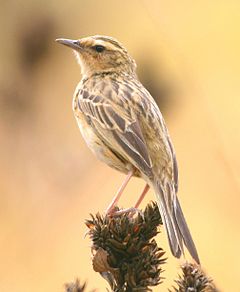
Nilgir Pipit (Anthus nilghiriensis) 18-Apr-2007 12-12-32 PM.JPG 
The pipits are a cosmopolitan genus, Anthus, of small passerine birds with medium to long tails. Along with the wagtails and longclaws, the pipits make up the family Motacillidae. The genus is widespread, occurring across most of the world, except the driest deserts, rainforests and the mainland of Antarctica.

They are slender, often drab, ground-feeding insectivores of open country. Like their relatives in the family, the pipits are monogamous and territorial. Pipits are ground nesters, laying up to six speckled eggs.
 
Taxonomy and evolution
The genus has more than forty species, making it the largest genus in terms of numbers in its family. The exact species limits of the genus are still a matter of some debate, with some checklists recognising only 34 species. For example, the Australasian pipit, Anthus novaeseelandiae, which is currently treated as nine subspecies found in New Zealand, Australia and New Guinea, once also included the Richard's pipit and paddyfield pipit of Asia, and the African pipit of Africa. In addition it has been suggested that the Australian and New Zealand populations be split, or even that New Zealand's subspecies found on its outlying Subantarctic Islands be split from the mainland species. In part the taxonomic difficulties arise due to the extreme similarities in appearance across the genus. Two species have been identified comparatively recently in South Africa, the long-tailed pipit in 1996 and the Kimberley pipit in 2002.

Within the family there is an additional species, the golden pipit, Tmetothylacus tennelus, which belongs to a distinct, monotypic genus. This species is apparently intermediate in appearance between the pipits and the longclaws, and is probably more closely related to the longclaws. One species of pipit, the yellow-breasted pipit, is sometimes split out into a genus Hemimacronyx, which is considered to be intermediate between the longclaws and pipits. The split was originally proposed based on morphological features but it has also found support based upon genetic analysis.

Buff-bellied pipits will wag their tail from side to side as well as up and down

Molecular studies of the pipits suggest that the genus arose in East Asia around seven million years ago (mya), during the Miocene, and that the genus had spread to the Americas, Africa and Europe between 5 and 6 mya. Speciation rates were high during the Pliocene (5.3 to 2.6 mya ) but have slowed down so during the Pleistocene. Repeated dispersal between continents seems to have been important in generating new species in Eurasia, Africa and North America, rather than species arising by radiation once a continent was reached. In South America, however, vicariance appears to have played an important role in speciation.
 
Morphology
The pipits are generally highly conservative in appearance. They are generally between 16 to 21 cm (6.3–8.3 in) in length, although the smallest species, the short-tailed pipit, is only 11.5 to 12.5 cm (4.5–4.9 in). In weight they range from 15 to 38 g (0.53–1.34 oz). Like all members of the family they are slender, short necked birds with long tails, long slender legs with elongated (in some cases very elongated) hind claws. The length of the hindclaw varies with the habits of the species, more arboreal species have shorter, more curved hindclaws than the more terrestrial species. The bills are generally long, slender and pointed. In both size and plumage there is little differences between the sexes. One unusual feature of the pipits, which they share in common with the rest of their family but not the rest of the passerines, is that the tertials on the wing entirely cover the primary flight feathers. This is thought to be a feature to protect the primaries, which are important to flight, from the sun, which causes the feathers to fade and become brittle if not protected.

The plumage of the pipits is generally drab and brown, buff or faded white. The undersides are usually darker than the top, and there is a variable amount of barring and streaking on the back, wings and breast. The drab mottled brown colours provide some camouflage against the soil and stones they are generally found on. A few species have slightly more colourful breeding plumages, for example the rosy pipit has greenish edges on the wing feathers. The yellow-breasted pipit, if it is retained in this genus, is quite atypical in having bright yellow plumage on the throat breast and belly.

Pipits are morphologically similar to some larks. However the two groups are quite distantly related: the lark family Alaudidae is part of the Sylvioidea superfamily, rather than the Passeroidea, where the pipits are placed. Morphological differences between the two groups of birds are in fact plentiful. Anatomical differences include a differently-structured syrinx, differences in the structure of the tarsus, and in many lark genera, the presence of a distinct tenth primary, a fourth tertial, and feathers at least partially covering the nostrils. Bill shape differs between larks and pipits: larks have an evenly sloping culmen, whereas most pipits have a small hump over the nostrils, and lark bills are generally heavier, reflecting differences in diet. There are differences in the feather tracts of the two groups: while many larks have crests, no pipit does; pipits have only one prominent row of scapulars, whereas larks have two.
 
Distribution and habitat
The pipits have a cosmopolitan distribution, occurring across most of the world's land surface. They are the only genus in their family to occur widely in the Americas (two species of wagtail marginally occur in Alaska as well). Three species of pipit occur in North America (one, like the wagtails, only occurs here), and seven species occur in South America. The remaining species are spread throughout Eurasia, Africa and Australia, along with two species restricted to islands in the Atlantic. Some six species occur on more than one continent.

As might be expected from a genus with such a wide distribution, the pipits are found in an equally wide range of habitats. They occur in most types of open habitat, although they are absent from the very driest deserts. They are mostly associated with some kind of grassland, from sea-level to alpine grasslands. The rock pipit and South Georgia pipit can be found in the rocks and cliffs of the seashore, whereas a number of species are restricted (for part of the year in some cases) to alpine areas. The family also ranges from the northern tundra and the subantarctic islands of New Zealand and the South Georgia group to the tropics. They are absent from tropical rainforests, but a few species are associated with open woodland, for example the wood pipit of southern Africa which is found in open woodland savanna and miombo woodland.

The pipits range from entirely sedentary to entirely migratory. Insular species like the Berthelot's pipit, which is endemic to Madeira and the Canary Islands, are entirely sedentary, as are some species in warmer areas like the Nilgiri pipit. Other species are partly nomadic during the non-breeding season, like the long-legged pipit of central Africa or the ochre-breasted pipit of South America. These seasonal movements are in response to conditions in the environment, and are poorly understood and unpredictable. Longer, more regular migrations between discrete breeding and wintering grounds are undertaken by several species. The tree pipit which breeds in Europe and northern Asia, winters in Asia and sub-Saharan Africa, a pattern of long-distance migration shared with other northerly species. Species may also be partly migratory, with northern populations being migratory but more temperate populations being resident (like the meadow pipit in Europe). The distances involved do not have to be that long; the mountain pipit of southern Africa breeds in the Drakensberg of South Africa and migrates north only as far as Angola and Zambia. Migration is usually undertaken in groups, and may happen both during the day and at night. There is some variation in this, for example the Sprague's pipit of North America apparently only migrates by day.
 
Behaviour
The pipits are active terrestrial birds that usually spend most of their time on the ground. They will fly in order to display during breeding, while migrating and dispersing, and also when flushed by danger. A few species make use of trees, perching in them and flying to them when disturbed. Low shrubs, rocks and termite nests may also be used as vantage points. Like their relatives the wagtails, pipits engage in tail-wagging. The way in which a pipit does this can provide clues to its identity in otherwise similar looking species. Upland pipits, for example, flick their tails quite quickly, as opposed to olive-backed pipits which wag their tails more gently. In general pipits move their tails quite slowly. The buff-bellied pipit wags its tail both up and down and from side to side. The exact function of tail-wagging is unclear; in the related wagtails it is thought to be a signal to predators of vigilance.
 
Berthelot's pipit is restricted to the Atlantic islands of Madeira and the Canary Islands

Diet and feeding
The diet of the pipits is dominated by small invertebrates. Insects are the most important prey items; among the types taken include flies and their larvae, beetles, grasshoppers and crickets, true bugs, mantids, ants, aphids and particularly the larvae and adults of moths and butterflies. Outside of insects other invertebrates taken include spiders and, rarely, worms and scorpions. They are generally catholic in their diet, the composition of their diet apparently reflecting the abundance of their prey in the location (and varying with the season). The diet consumed by adults may vary to that of the young birds; for example adult tree pipits take large numbers of beetles but do not feed many to their chicks. Species feeding on the seashore are reported to feed on marine crustaceans and molluscs. A few species have been reported to feed on small fish, beating them in the manner of a kingfisher having caught them. A few species also are reported as consuming berries and seeds.

Selasa, 08 September 2015

Orthonychidae

 Logrunner male lam jan08.jpg


The logrunners (Orthonyx) are a clade of birds which comprises three species of passerine birds endemic to Australia and New Guinea. Some authorities consider the Australian family Cinclosomatidae to be part of the Orthonychidae. The three species use their stiffened tails to brace themselves when feeding.

The species are:

    Papuan logrunner (Orthonyx novaeguineae)
    Australian logrunner (Orthonyx temminckii)
    Chowchilla (Orthonyx spaldingii)

The Australian logrunner, Orthonyx temminckii, is from northeastern New South Wales and southeast Queensland, where it is very local in its distribution, and strictly terrestrial in its habits. The wings are barred with white, and the chin, throat and breast are in the male pure white, but of a bright reddish-orange in the female. The remiges are very short, rounded and much incurved, showing a bird of weak flight. The rectrices are very broad, the shafts stiff, and towards the tip divested of barbs. The population which is found locally in New Guinea is now generally considered a separate species, the Papuan logrunner, Orthonyx novaeguineae.

The chowchilla, Orthonyx spaldingii, from north-east Queensland is of much greater size than either species of logrunner, and with a jet-black plumage, the throat being white in the male and orange-rufous in the female.
Taxonomy

The fossil record does not much help to determine the affiliations of the Orthonychidae. Three prehistoric species are known to science. The very large Orthonyx hypsilophus from Green Waterhole Cave and an undescribed species found in Pyramids Cave which was a bit smaller than the Australian logrunner are probably of Late Pleistocene age. Orthonyx kaldowinyeri is known from Middle or Late Miocene deposits of Riversleigh; it is the oldest and smallest species known to date (Boles, 1993).
Behaviour and ecology

Logrunners are semi-terrestrial birds of weak flight. They are strictly carnivorous, with insects and larvae being their chief food, whilst the larger chowchilla will also eat small lizards. They find their food by digging in the soil, using their spiny tails as a support in the wet forest.
Social structure and breeding

Logrunners have a somewhat unusual social structure. They are basically monogamous, but male offspring are often retained on the natal territory for more than a year after fledging. Despite this, only the female ever feeds the young; the much larger males stay primarily for the purpose of territorial defence and protecting the female from predation. Similar patterns of retention of young without alloparental care also occur in the speckled warbler, the corvid genus Perisoreus and the bustard genus Eupodotis.

Like the lyrebirds, logrunners typically breed in the southern winter from June to September, though this is often extended depending on weather conditions by a month or more. Both the chowchilla and the Papuan logrunner lay only one egg, whilst the Australian logrunner typically lays two though a few reports exist of clutches of one or even three. The eggs are very unusual in their tubular shape, and are pure white in colour, whilst the incubation period is among the longest for any songbird. The young generally become independent of the female in two to two and a half weeks, which is an exceptionally short time for an insectivorous altricial Australian bird, where parental dependence of forty to sixty days post-fledging is typical. This is probably why, unlike in birds of drier habitats in Australia, alloparental care is superfluous for rearing young and may actually increase the risk of predation. The nests are domed and constructed entirely of sticks, and are located on the ground below a tree. They have special coverings to prevent the extremely heavy downpours typical of the eastern Australian coast from damaging the egg(s).
Males are described as performing dancing antics like those of the lyrebirds.

Australo-Papuan babbler

Chestnut-crowned Babbler bowra apr07.jpg


The Pomatostomidae (Australo-Papuan or Australasian babblers, also known as pseudo-babblers) are small to medium-sized birds endemic to Australia-New Guinea. For many years, the Australo-Papuan babblers were classified, rather uncertainly, with the Old World babblers (Timaliidae), on the grounds of similar appearance and habits. More recent research, however, indicates that they are too basal to belong the Passerida - let alone the Sylvioidea where the Old World babblers are placed - and they are now classed as a separate family close to the Orthonychidae (logrunners). Five species in one genus are currently recognised, although the red-breasted subspecies rubeculus of the grey-crowned babbler may prove to be a separate species.

Description

The Australo-Papuan babblers are medium-sized terrestrial birds with sombre plumage and long decurved bills. They range in size from 17–27 cm (7–11 in) in length and 30-85 g (1-3 oz) in weight. The wings are short and round, and the tail is long and often held fanned which makes it look broad as well. The feet and legs are strong and adapted to a terrestrial existence. There is no sexual dimorphism in the plumage, which is composed of brown, russet and grey colours, with all but the Papuan babbler having striking white markings on the face and throat. The plumage of juvenile birds is similar to that of adults.
Behaviour and ecology

All five species are ground-feeding omnivores and highly social. Babblers live in family groups and small flocks of up to about 20 individuals and forage communally, calling loudly to one another all day long. They feed principally on insects and other invertebrates, but will also take seeds, fruits and small vertebrates. Most food is obtained on the ground, although they will also forage in low bushes; the grey-crowned babbler and Papuan babbler feed more extensively in vegetation than the other species. The long bill is used to probe and overturn large objects. They will also hold objects with one foot and hammer them with the bill in order to extract food.
Breeding

Australo-Papuan babblers are monogamous breeders which defend territories. The breeding pair will be aided in breeding by a number of helpers from its group. This is similar to the cooperative breeding system used by the fish species Neolamprologus pulcher with the difference being that N. pulcher are polygynous instead of monogamous. A number of groups may have more than one breeding pair. Extra male helpers aid the male in his responsibilities whereas the females aid the main breeding female in hers. They have an extended breeding season. Australo-Papuan babblers construct large nests for communal roosting, and these nests may be used for breeding, or new nests may be constructed. There may be a large number of nests used by the group in a small area. When the female is breeding she alone uses the breeding nest. Construction, both of roosting and breeding nests, is undertaken by all birds in the group. Between one to six eggs are laid (the number and range varies by species) and are usually incubated by the breeding female alone (although a helper female may aid occasionally). The breeding male and other helper males feed the breeding female during incubation. Incubation lasts between 19–25 days. The female broods the chicks until they are able to thermoregulate, and the chicks fledge after 16–23 days. After leaving the nest, the chicks will continue to be fed by the adults for a number of months.

Acanthizidae

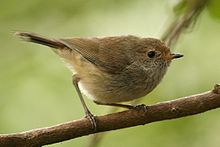
 Brown Thornbill.jpg


The Acanthizidae, also known as the Australasian warblers, are a family of passerine birds which include gerygones, thornbills, and scrubwrens. The Acanthizidae consists of small to medium passerine birds, with a total length varying between 8 and 19 centimetres (3.1 and 7.5 in). They have short rounded wings, slender bills, long legs, and a short tail. Most species have olive, grey, or brown plumage, although some have patches of a brighter yellow. The smallest species of acanthizid, and indeed the smallest Australian passerine, is the weebill, the largest is the pilotbird.

Distribution and habitat

Acanthizids are native to Australia, Indonesia, New Zealand, and the south-west Pacific. Most species are found in Australia and New Guinea, with Australia having thirty-five endemic species and New Guinea fifteen. A single species is found in Vanuatu, New Caledonia and the Solomon Islands, and three species occur in the New Zealand region, including endemic species in the Chatham Islands and Norfolk Island. In Asia two species are restricted to Indonesia and another is found in the Philippines and on mainland Asia. Most species are sedentary, with the exception of the gerygones. The family occupies a range of habitats from rainforests to arid deserts.
Behaviour and ecology

Most species are terrestrial, feeding primarily on insects, although also eating some seeds. In particular the whitefaces consume large numbers of seeds, and other species will take fruits. The secretions of sap-sucking insects are favoured by some species, as are the insects themselves. Some species are less terrestrial, such as the weebill, which forages in the treetops, or the rock-dwelling rockwarbler. Rainforest species lay one to two eggs in a clutch, and species in the deserts and Tasmania lay three to four. Acanthizids are unusual for passerines in their long incubation periods, which rival those of large songbirds like the Corvidae. Also, despite their long incubation period hatching is completely synchronous and within-brood mortality completely absent. Acanthizids are relatively long-lived, with many species living to over ten years of age in the wild and cooperative breeding is found in the weebill and with a lesser degree of development in all whitefaces and most species of Sericornis and Acanthiza.
Status and conservation

Most taxa are considered as least concern. One species - the Lord Howe gerygone (Gerygone insularis) - became extinct by rat predation in the early 1930s. The Norfolk Island gerygone (Gerygone modesta) is vulnerable, and the chestnut-breasted whiteface (Aphelocephala pectoralis) is regarded as near threatened.
Taxonomy and systematics

Following the Sibley-Ahlquist taxonomy (1990) they were previously regarded as subfamily Acanthizinae within the Pardalotidae family. However, current revisions (Christidis & Boles, 1994; Schodde & Mason 1999) don't support this arrangement. The Dasyornithidae (which include the bristlebirds) are variously seen either as subfamily Dasyornithinae within the Acanthizidae or Pardalotidae family or as own family (Schodde & Mason 1999).

The Acanthizidae family consists of the two subfamilies Sericornithinae and Acanthizinae (Schodde & Mason 1999), 14 genera, 63 species and 196 taxa.

Quetzal

 ResplendentQuetzal.jpg


Quetzals (/kɛtsˈɑːl/ or /ˈkɛtsəl/) are strikingly colored birds in the trogon family.

They are found in forests and woodlands, especially in humid highlands, with the five species from the genus Pharomachrus being exclusively Neotropical, while the single Euptilotis species is almost entirely restricted to Baja Verapaz, Guatemala. They are fairly large (all over 32 cm or 13 inches long), slightly bigger than other trogon species.

Quetzals have iridescent green or golden-green wing coverts, back, chest and head, with a red belly. They are strongly sexually dimorphic, and parts of the females' plumage are brown or grey. These largely solitary birds feed on fruits, berries, insects and small vertebrates (such as frogs). Even with their famous bright plumage, they can be hard to see in their natural wooded habitats.

Etymology

The name "quetzal" is from Nahuatl quetzalli [keˈt͡salːi], "large brilliant tail feather" (American Audubon Dictionary) or "tail coverts of the quetzal" ( Merriam–Webster's Collegiate Dictionary), from the Nahuatl root quetz = "stand up" used to refer to an upstanding plume of feathers.

The word "quetzal" was originally used for just the resplendent quetzal, the long-tailed quetzal of southern Mexico and Central America, which is the national bird and the name of the currency of Guatemala. It still often refers to that bird specifically but now also names all the species of the genera Pharomachrus and Euptilotis.

Pharomachrus is from Ancient Greek pharos, "mantle", and makros, "long", referring to the wing and tail coverts of the resplendent quetzal (the second h is unexplained).
Species

    Genus Pharomachrus:
        Crested quetzal, Pharomachrus antisianus.
        Golden-headed quetzal, Pharomachrus auriceps.
        White-tipped quetzal, Pharomachrus fulgidus.
        Resplendent quetzal, Pharomachrus mocinno.
        Pavonine quetzal, Pharomachrus pavoninus.
    Genus Euptilotis:
        Eared quetzal, Euptilotis neoxenus.

Euptilotis neoxenus is related to Pharomachrus and is called the eared quetzal by some authorities, such as the American Ornithologists' Union, but the eared trogon by others.

Golden pheasant

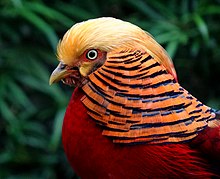
Portrait of a Golden Pheasant.JPG


The golden pheasant or Chinese pheasant, (Chrysolophus pictus) is a gamebird of the order Galliformes (gallinaceous birds) and the family Phasianidae (pheasants). It is native to forests in mountainous areas of western China, but feral populations have been established in the United Kingdom, Canada, United States, Mexico, Colombia, Peru, Bolivia, Chile, Argentina, Uruguay, Falkland Islands, Germany, Belgium, Netherlands, France, Ireland, Australia and New Zealand. In England they may be found in East Anglia in the dense forest landscape of the Breckland.

The adult male is 90–105 cm in length, its tail accounting for two-thirds of the total length. It is unmistakable with its golden crest and rump and bright red body. The deep orange "cape" can be spread in display, appearing as an alternating black and orange fan that covers all of the face except its bright yellow eye with a pinpoint black pupil.

Males have a golden-yellow crest with a hint of red at the tip. The face, throat, chin, and the sides of neck are rusty tan. The wattles and orbital skin are both yellow in colour, and the ruff or cape is light orange. The upper back is green and the rest of the back and rump is golden-yellow. The tertiaries are blue whereas the scapulars are dark red. Other characteristics of the male plumage are the central tail feathers, black spotted with cinnamon, as well as the tip of the tail being a cinnamon buff. The upper tail coverts are the same colour as the central tail feathers. The male also has a scarlet breast, and scarlet and light chestnut flanks and underparts. Lower legs and feet are a dull yellow.

The female (hen) is much less showy, with a duller mottled brown plumage similar to that of the female common pheasant. She is darker and more slender than the hen of that species, with a proportionately longer tail (half her 60–80 cm length). The female's breast and sides are barred buff and blackish brown, and the abdomen is plain buff. She has a buff face and throat. Some abnormal females may later in their lifetime get some male plumage. Lower legs and feet are a dull yellow.

Despite the male's showy appearance, these hardy birds are very difficult to see in their natural habitat, which is dense, dark young conifer forests with sparse undergrowth. Consequently, little is known about their behaviour in the wild.

They feed on the ground on grain, leaves and invertebrates, but they roost in trees at night. While they can fly, they prefer to run. If startled, they can suddenly burst upwards at great speed and with a distinctive wing sound.
Hasil gambar untuk Golden pheasant  
Although they can fly in short bursts, they are quite clumsy in flight and spend most of their time on the ground. Golden pheasants lay 8-12 eggs at a time and will then incubate these for around 22–23 days. They tend to eat berries, grubs, seeds and other types of vegetation.

The golden pheasant is commonly found in zoos and aviaries, but often as hybrid specimens that have the similar Lady Amherst's pheasant in their lineage.

There are also different mutations of the golden pheasant known from birds in captivity, including the dark-throated, yellow, cinnamon, salmon, peach, splash, mahogany and silver. In aviculture, the wild type is referred to as "red golden" to differentiate it from these mutations.

Northern cardinal

 Cardinalis cardinalis -Columbus, Ohio, USA-male-8 (1).jpg


The northern cardinal (Cardinalis cardinalis) is a North American bird in the genus Cardinalis; it is also known colloquially as the redbird or common cardinal. It can be found in southern Canada, through the eastern United States from Maine to Texas and south through Mexico. It is found in woodlands, gardens, shrublands, and swamps.

The northern cardinal is a mid-sized songbird with a body length of 21 cm (8.3 in). It has a distinctive crest on the head and a mask on the face which is black in the male and gray in the female. The male is a vibrant red, while the female is a dull reddish olive. The northern cardinal is mainly granivorous, but also feeds on insects and fruit. The male behaves territorially, marking out his territory with song. During courtship, the male feeds seed to the female beak-to-beak. A clutch of three to four eggs is laid, and two to four clutches are produced each year. It was once prized as a pet, but its sale as a cage bird was banned in the United States by the Migratory Bird Treaty Act of 1918.

Taxonomy

The northern cardinal is one of three birds in the genus Cardinalis and is included in the family Cardinalidae, which is made up of passerine birds found in North and South America.

The northern cardinal was one of the many species originally described by Linnaeus in his 18th-century work, Systema Naturae. It was initially included in the genus Loxia, which now contains only crossbills. In 1838, it was placed in the genus Cardinalis and given the scientific name Cardinalis virginianus, which means "Virginia cardinal". In 1918, the scientific name was changed to Richmondena cardinalis to honor Charles Wallace Richmond, an American ornithologist. In 1983, the scientific name was changed again to Cardinalis cardinalis and the common name was changed to "northern cardinal", to avoid confusion with the seven other species also termed cardinals.
The common name, as well as the scientific name, of the northern cardinal refers to the cardinals of the Roman Catholic Church, who wear distinctive red robes and caps. The term "northern" in the common name refers to its range, as it is the northernmost cardinal species.

Subspecies

There are 19 subspecies:

    C. c. cardinalis (Linnaeus, 1758)
    C. c. affinis Nelson, 1899
    C. c. canicaudus Chapman, 1891
    C. c. carneus (Lesson, 1842)
    C. c. clintoni (Banks, 1963)
    C. c. coccineus Ridgway, 1873
    C. c. flammiger J.L. Peters, 1913
    C. c. floridanus Ridgway, 1896
    C. c. igneus S.F. Baird, 1860
    C. c. littoralis Nelson, 1897
    C. c. magnirostris Bangs, 1903
    C. c. mariae Nelson, 1898
    C. c. phillipsi Parkes, 1997
    C. c. saturatus Ridgway, 1885
    C. c. seftoni (Huey, 1940)
    C. c. sinaloensis Nelson, 1899
    C. c. superbus Ridgway, 1885
    C. c. townsendi (van Rossem, 1932)
    C. c. yucatanicus Ridgway, 1887
Hasil gambar untuk northern cardinal
Description

The northern cardinal is a mid-sized songbird with a body length of 20–23.5 cm (7.9–9.3 in) and a wingspan of 25–31 cm (9.8–12.2 in). The adult weighs from 33.6–65 g (1.19–2.29 oz), with an average 44.8 g (1.58 oz).The male averages slightly larger than the female. The adult male is a brilliant crimson red color with a black face mask over the eyes, extending to the upper chest. The color becomes duller and darker on the back and wings. The female is fawn, with mostly grayish-brown tones and a slight reddish tint on the wings, the crest, and the tail feathers. The face mask of the female is gray to black and is less defined than that of the male. Both sexes possess prominent raised crests and bright coral-colored beaks. The beak is cone-shaped and strong. Young birds, both male and female, show coloring similar to the adult female until the fall, when they molt and grow adult feathers. They are brown above and red-brown below, with brick-colored crest, forehead, wings, and tail. The legs and feet are a dark pink-brown. The iris of the eye is brown. The plumage color of the males is produced from carotenoid pigments in the diet. Coloration is produced from both red pigments and yellow carotenoid pigments. Northern cardinal males possess the ability to metabolize carotenoid pigments to create plumage pigmentation of a color different from the ingested pigment. When fed only yellow pigments, males become a pale red color, rather than a yellow. However, there are rare "yellow morph" cardinals, where all feathers (except for black face mask) and beak are a moderate yellow color.

Distribution and habitat

Northern cardinals are numerous across the eastern United States from Maine to Texas and in Canada in the provinces of Ontario, Quebec, New Brunswick and Nova Scotia. Its range extends west to the U.S.–Mexico border and south through Mexico to the Isthmus of Tehuantepec, northern Guatemala, and northern Belize. An allopatric population is found on the Pacific slope of Mexico from Jalisco to Oaxaca; note that this population is not shown on the range map. The species was introduced to Bermuda in 1700. It has also been introduced in Hawaii and southern California. Its natural habitat is woodlands, gardens, shrublands, and swamps.

Greater bird-of-paradise

 Paradisaea apoda -Bali Bird Park-6.jpg


The greater bird-of-paradise (Paradisaea apoda) is a bird-of-paradise in the genus Paradisaea.

Carolus Linnaeus named the species Paradisaea apoda, or "legless bird-of-paradise", because early trade-skins to reach Europe were prepared without wings or feet by natives; this led to the misconception that these birds were beautiful visitors from paradise that were kept aloft by their plumes and never touched the earth until death.
Description

The greater bird-of-paradise is the largest member in the genus Paradisaea, with males measuring up to 43 cm (17 in) (excluding the long twin tail wires). The female is smaller, at only 35 cm (14 in). The plumage of this species is also sexually dimorphic. The male has an iridescent green face and a yellow glossed with silver iridescence crown, head and nape. The rest of the body plumage is maroon-brown. The flank plumes, used in displays, are yellow at the base, turning white and streaked with maroon. The female has unbarred maroon brown plumage. In both sexes the iris is yellow and the bills blue.Distribution

The greater bird-of-paradise is distributed to lowland and hill forests of southwest New Guinea and Aru Islands, Indonesia. The diet consists mainly of fruits, seeds and small insects. A small population was introduced by Sir William Ingram in 1909-1912 to Little Tobago Island of West Indies in an attempt to save the species from extinction due to overhunting for plume trades. The introduced populations survived until at least 1966, but most likely are extinct now.

A common species throughout its native range, the greater bird-of-paradise is evaluated as Least Concern on the IUCN Red List of Threatened Species. It is listed on Appendix II of CITES.
References

BirdLife International (2012). "Paradisaea apoda". IUCN Red List of Threatened Species. Version 2013.2. International Union for Conservation of Nature. Retrieved 26 November 2013.
Jobling, James A. (1991). A Dictionary of Scientific Bird Names. Oxford: Oxford University Press. pp. 15–16. ISBN 0-19-854634-3.
Firth, Clifford B.; Firth, Dawn W. (2009). "Family Paradisaeidae (Birds-of-paradise)". In del Hoyo, Josep; Elliott, Andrew; Christie, David. Handbook of the Birds of the World. Volume 14, Bush-shrikes to Old World Sparrows. Barcelona: Lynx Edicions. pp. 487–488. ISBN 978-84-96553-50-7.

    Dinsmore, James J. (1970). "Courtship Behavior of the Greater Bird of Paradise". The Auk 87 (2): 305–321. doi:10.2307/4083922.

    The World Atlas of Birds. Galley Press.

Spix's macaw

AraSpixiSmit.jpg


Spix's macaw (Cyanopsitta spixii), also known as the little blue macaw, is a macaw native to Brazil. It is a member of Arini tribe in the subfamily Arinae (Neotropical parrots), part of the family Psittacidae (the true parrots). It was first described by German naturalist Georg Marcgrave, when he was working in the State of Pernambuco, Brazil in 1638 and it is named for German naturalist Johann Baptist von Spix, who collected a specimen in 1819 on the bank of the Rio São Francisco in northeast Bahia in Brazil.

The bird is a medium size parrot weighing about 300 grams (0.66 lb), smaller than most of the large macaws. Its plumage is various shades of blue, with a grey-blue head, light blue underparts, and vivid blue upperparts. Males and females are identical in appearance, the females being a little smaller on average.


The species inhabited riparian Caraibeira (Tabebuia aurea) woodland galleries in the drainage basin of the Rio São Francisco within the Caatinga dry forest climate of interior northeastern Brazil. It had a very restricted natural habitat due to its dependence on the tree for nesting, feeding and roosting. It fed primarily on seeds and nuts of Caraiba and various Euphorbiaceae (spurge) shrubs, the dominant vegetation of the Caatinga. Due to deforestation in its limited range and specialized habitat, the bird has been rare in the wild throughout the twentieth century. It has always been very rare in captivity, partly due to the remoteness of its natural range.

The IUCN regard the Spix's macaw as critically endangered and possibly extinct in the wild. Its last known stronghold in the wild was in northeastern Bahia, Brazil and the last known wild bird was a male that vanished in 2000. The species is now maintained through a captive breeding program at several conservation organizations under the aegis of the Brazilian government. It is listed on CITES Appendix I, which makes trade illegal except for legitimate conservation, scientific or educational purposes.

The Brazilian government department of natural resources (ICMBio) is conducting a project Ararinha-Azul with an associated plan to restore the species to the wild as soon as sufficient breeding birds and restored habitat are available.

Parakeet


A parakeet is any one of a large number of small to medium-sized species of parrot, in multiple genera, that generally have long tail feathers. Older spellings still sometimes encountered are paroquet or paraquet.
Species

The Australian budgerigar, also known as "budgie" or English parakeet or keet, Melopsittacus undulatus, is probably the most common parakeet. It was first described by zoologists in 1891. It is the most popular species of parakeet kept as a pet in North America and Europe.

The term "grass parakeet" (or grasskeet) refers to a large number of small Australian parakeets native to grasslands such as the Neophema genus and the princess parrot. The Australian rosellas are also parakeets. Many of the smaller, long-tailed species of lories may be referred to as "lorikeets". The vernacular name ringnecked parakeet (not to be confused with the Australian ringneck) refers to a species of the Psittacula genus native to Africa and Asia that is popular as a pet and has become feral in many cities outside its natural range.

In aviculture, the term "conure" is used for small to medium-sized parakeets of the genera Aratinga, Pyrrhura, and a few other genera of the tribe Arini, which are mainly endemic to South America. As they are not all from one genus, taxonomists tend to avoid the term. Other South American species commonly called parakeets include the genus Brotogeris parakeets, the monk parakeet, and lineolated parakeets, although lineolateds have short tails.

A larger species may be referred to as "parrot" or "parakeet" interchangeably. For example, "Alexandrine parrot" and "Alexandrine parakeet" are two common names for the same species, Psittacula eupatria, which is one of the largest species normally referred to as a parakeet.
Hasil gambar untuk parkit
Many different species of parakeets are bred and sold commercially as pets, the budgerigar being the third most popular pet in the world, after cats and dogs.
Breeding

Parakeets often breed more readily in groups but there can be conflicts between breeding pairs and individuals especially if space is limited. The presence of other parakeets encourages a pair to breed, which is why breeding in groups is more successful, however many breeders choose to breed in pairs to avoid conflicts and because that way they know for sure which parents produced any given birds. Parakeets produce about six to eight eggs if the parakeet successfully lays eggs.

lovebird

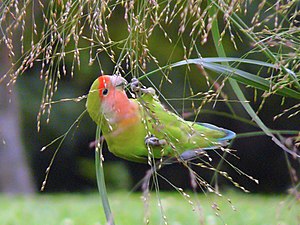
 Agapornis roseicollis -eating grass seeds-8.jpg


A lovebird is one of nine species of the genus Agapornis (Greek: αγάπη agape 'love'; όρνις ornis 'bird'). They are a social and affectionate small parrot. Eight species are native to the African continent, and the grey-headed lovebird is native to Madagascar. Their name stems from the parrots' strong, monogamous pair bonding and the long periods which paired birds spend sitting together. Lovebirds live in small flocks and eat fruit, vegetables, grasses and seed. Black-winged lovebirds also eat insects and figs, and the black-collared lovebirds have a special dietary requirement for native figs, making them problematic to keep in captivity.

Some species are kept as pets, and several color mutations were selectively bred in aviculture. Their average lifespan is 10 to 15 years.

Description

Lovebirds are 13 to 17 centimeters in length and 40 to 60 grams in weight. They are among the smallest parrots, characterized by a stocky build, a short blunt tail, and a relatively large, sharp beak. Wildtype lovebirds are mostly green with a variety of colors on their upper body, depending on the species. The Fischer's lovebird, black-cheeked lovebird, and the masked lovebird have a prominent white ring around their eyes. Many color mutant varieties have been produced by selective breeding of the species that are popular in aviculture.

Taxonomy

The lovebird genus comprises nine species of which five are monotypic and four are divided into subspecies. Eight of them are native in the mainland of Africa and the Madagascar lovebird is native to Madagascar. In the wild the different species are separated geographically.

Traditionally, lovebirds are divided into three groups:

the sexually dimorphic species: Madagascar, Abyssinian, and red-headed lovebird
the intermediate species: peach-faced lovebird
the white-eye-ringed species: masked, Fischer's, Lilian's, and black-cheeked lovebirds

However, this division is not fully supported by phylogenetic studies, as the species of the dimorphic group are not grouped together in a single clade.
Hasil gambar untuk lovebird
Species and subspecies:

Rosy-faced lovebird, Agapornis roseicollis, (Vieillot, 1818)—or peach-faced lovebird
Agapornis roseicollis catumbella, B.P. Hall, 1952
Agapornis roseicollis roseicollis, (Vieillot 1818)
Yellow-collared lovebird, Agapornis personatus, Reichenow, 1887—or masked lovebird
Fischer's lovebird, Agapornis fischeri, Reichenow, 1887
Lilian's lovebird, Agapornis lilianae, Shelley, 1894—or Nyasa lovebird
Black-cheeked lovebird, Agapornis nigrigenis, W.L. Sclater, 1906
Grey-headed lovebird, Agapornis canus, (Gmelin, 1788)—or Madagascar lovebird
Agapornis canus ablectaneus, Bangs, 1918
Agapornis canus canus, (Gmelin, 1788)
Black-winged lovebird, Agapornis taranta, (Stanley, 1814)—or Abyssinian lovebird
Red-headed lovebird, Agapornis pullarius, (Linnaeus, 1758)—or red-faced lovebird
Agapornis pullarius pullarius, (Linnaeus, 1758)
Agapornis pullarius ugandae, Neumann, 1908
Black-collared lovebird, Agapornis swindernianus, (Kuhl, 1820)—or Swindern's lovebird
Agapornis swindernianus emini, Neumann, 1908
Agapornis swindernianus swindernianus, (Kuhl, 1820)
Agapornis swindernianus zenkeri, Reichenow, 1895

finch bird

 Fringilla coelebs chaffinch male edit2.jpg


The true finches are small to medium-sized passerine birds in the family Fringillidae. Finches have stout conical bills adapted for eating seeds and often have colourful plumage. They occupy a great range of habitats where they are usually resident and do not migrate. They have a world-wide distribution except for Australia and the polar regions.

Many birds in other families are also commonly called "finches", including some species in the very similar-looking waxbills or estrildid finches (family Estrildidae) of the Old World tropics and Australia; several groups of the bunting and American sparrow family (Emberizidae); and the Darwin's finches of the Galapagos islands, now considered members of the tanager family (Thraupidae).

Systematics and taxonomy

The scientific name Fringillidae, comes from the Latin word fringilla for the common chaffinch (Fringilla coelebs), a member of the family which is common in Europe. The name was coined by the English zoologist William Elford Leach in 1820. The Fringillidae family is divided into three subfamilies, the Fringillinae containing a single genus with the chaffinches, the Carduelinae containing 183 species divided into 49 genera, and the Euphoniinae containing the Euphonia and the Chlorophonia.
The taxonomy of the finch family, in particular the cardueline finches, has a long and complicated history. The study of the relationship between the taxa has been confounded by the recurrence of similar morphologies due to the convergence of species occupying similar niches. In 1968 the America ornithologist Raymond Andrew Paynter Jnr. wrote:

    Limits of the genera and relationships among the species are less understood - and subject to more controversy - in the carduelines than in any other species of passerines, with the possible exception of the estrildines


Beginning in around 1990 a series of phylogenetic studies based on mitochondrial and nuclear DNA sequences resulted in substantial revisions being made to the taxonomy. Several groups of birds that had previously been assigned to other families were found to be related to the finches. The Neotropical Euphonia and the Chlorophonia were formerly placed in the tanager family Thraupidae due to their similar appearance but analysis of mitochondrial DNA sequences revealed that both genera were more closely related to the finches. They are now placed in a separate subfamily Euphoniinae within the Fringillidae.The Hawaiian honeycreepers were at one time placed in their own family, Drepanididae but were found to be closely related to the Carpodacus rosefinches and are now placed within the Carduelinae subfamily. The three largest genera, Carpodacus, Carduelis and Serinus were found to be polyphyletic. Each was split into monophyletic genera. The American rosefinches were moved from Carpodacus to Haemorhous. Carduelis was split by moving the greenfinches to Chloris and a large clade into Spinus leaving just three species in the original genus. Thirty seven species were moved from Serinus to Crithagra leaving eight species in the original genus.
Although Przewalski's "rosefinch" (Urocynchramus pylzowi) has ten primary flight feathers rather than the nine primaries of other finches, it was sometimes classified in the Carduelinae. It is now assigned to a distinct family, Urocynchramidae, monotypic as to genus and species, and with no particularly close relatives among the Passeroidea.
Fossil remains of true finches are rare, and those that are known can mostly be assigned to extant genera at least. Like the other Passeroidea families, the true finches seem to be of roughly Middle Miocene origin, around 20-10 million years ago (Ma). An unidentifable finch fossil from the Messinian age, around 12 to 7.3 million years ago (Ma) during the Late Miocene subepoch, has been found at Polgárdi in Hungary.